
A co-managed IT responsibility matrix records who does each technology task, who approves the important decisions, who covers an absence, and what proves the work is complete. Calling a task “shared” does not answer those questions.
For a Portland business with an existing internal IT team, we recommend defining those boundaries around actual systems and workflows. The sample below is a starting point for discussion, not SMB Technologies' contractual scope or a universal division of duties.
Assign work and decision authority separately
Your internal team and provider may both perform technical work. Each business outcome still needs a named accountable owner.
For example, a provider might install updates while a business application owner approves a disruptive maintenance window. Access to the administration console does not give the technician authority to accept every business interruption.
The NIST Cybersecurity Framework 2.0 calls for clear cybersecurity roles and authorities, including coordinated responsibilities with suppliers and partners. That supports naming the decision-maker as well as the person doing the work; it does not prescribe the sample allocation below.
Our co-managed IT overview explains the support model. The responsibility matrix answers a more specific question: when the next task or incident arrives, who acts and who decides?
Some teams use a RACI model: responsible, accountable, consulted, and informed. You can use those labels, but plain role descriptions work too. Add coverage, escalation, and verification details so the document remains useful when someone is unavailable.
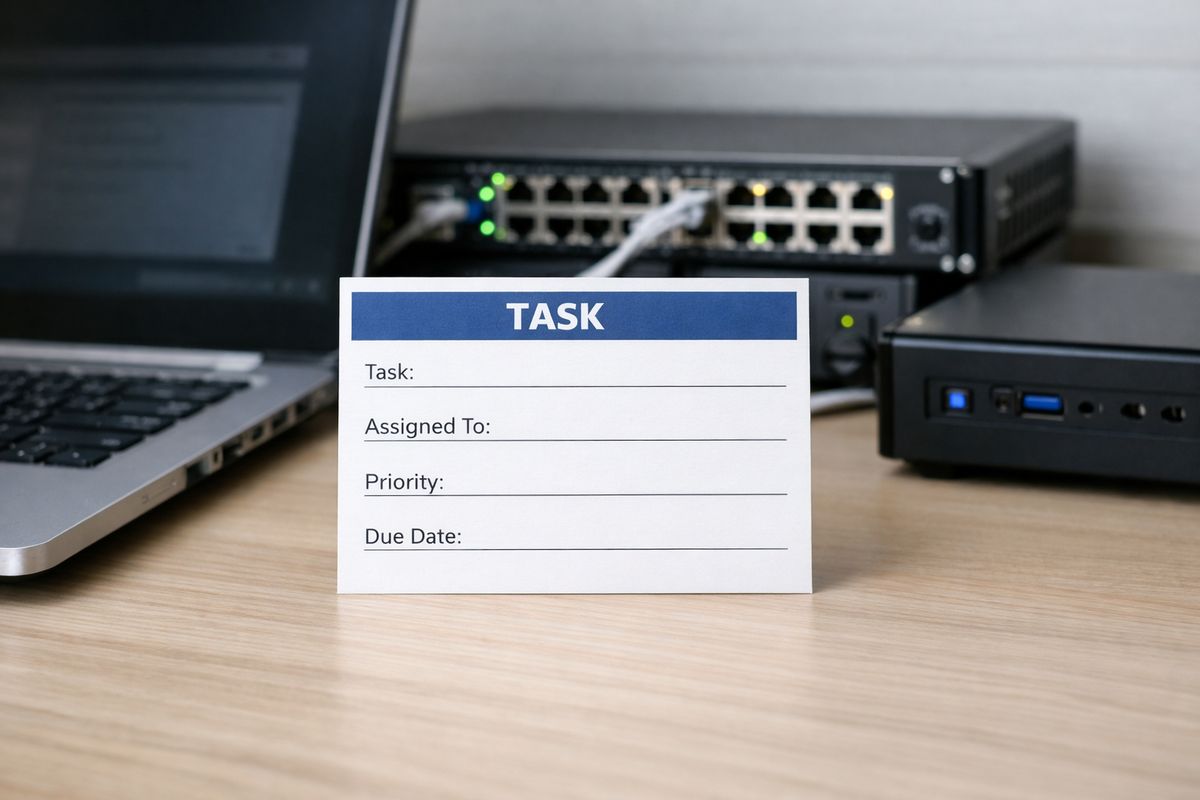
Build a task card your team can actually use
Start with an inventory of services, systems, locations, and existing support agreements. Then create a short card for each important responsibility.
Each card should name:
- The task, covered systems, and applicable support window.
- The role performing the work and any supporting role.
- The person authorized to approve the business decision.
- A backup contact with the necessary authority.
- The condition that triggers escalation and who receives it.
- The record or test that demonstrates completion.
A backup contact covers an unavailable person. An escalation contact handles a decision beyond the first person's authority. They are not automatically the same role.
Use role names in the template, then assign actual contacts in a controlled directory. Passwords, recovery codes, and confidential access instructions do not belong in a widely circulated matrix.
Sample responsibilities for a co-managed arrangement
The following assignments are hypothetical. Replace them with the duties and boundaries agreed by your business, internal team, and provider. Services described on our managed IT page are not automatic inclusions in every co-managed agreement.
Identity and access changes
In this sample, internal IT handles routine account changes, with provider assistance for agreed platforms. The manager or resource owner approves the permissions; a designated alternate covers their absence.
Completion evidence includes the approved request, the change record, and confirmation that the intended access works. Privileged access or an unusual request goes to the named security approver rather than being granted for convenience.
Devices, updates, and patch exceptions
The provider deploys updates to a listed device group during agreed windows, with internal IT coordinating application dependencies. The business system owner approves exceptions that could disrupt operations or leave a known risk unresolved.
A deployment report and an exception record show the outcome. A setting marked “automatic updates enabled” is not proof that every device received the update.
Name an alternate operations contact and explain where failed deployments or restart conflicts should go.
Help desk and specialist escalation
Internal IT owns first-line support until the provider accepts an agreed escalation. The handoff should identify the affected service, business impact, diagnostic work already completed, and the next responsible person.
The business service owner approves material workarounds or disruption. Evidence includes the accepted handoff and verified result, not merely a ticket marked closed.
Define escalation around the issue and authority involved, not a vague promise to “contact the team.”

Backup checks and restore tests
Routine backup review and recovery testing are different responsibilities. In this sample, the contracted provider checks job results and handles agreed exceptions. A failed backup goes to a named technical lead and business owner.
A separate task assigns who performs restore tests, who approves their scope, and who validates the recovered application. Testing should use an authorized environment and avoid overwriting production or triggering live transactions.
A successful backup job does not show that employees can use a recovered business service. Record technical results and business acceptance separately.
Security alerts and emergency decisions
Name who receives alerts, investigates them, and contacts the business. State whether the agreement includes monitoring, human review, containment, or wider incident-response work, and during which hours.
Preauthorized emergency action needs defined boundaries. For example, an agreed responder might be permitted to suspend a specified account under documented conditions, preserve relevant evidence, and notify the authorized business contact.
Wider shutdowns, significant disruption, spending, and acceptance of remaining risk still need the designated business authority or an authorized alternate. A provider's technical capability does not establish unlimited decision-making authority.
The recovery task should also identify who verifies identity, checks permissions, completes corrective work, and authorizes restored access. A closed alert is not proof that the underlying issue has been resolved.
Vendor coordination and documentation
When an application stops working, several suppliers may be involved. Assign one coordinator to maintain the shared timeline, case references, findings, and next decision.
That coordinator does not control another vendor's response time or service availability. Confirm the business has the support entitlement needed to open and escalate the case.
The role making a system change should update the affected records. An internal owner should confirm that approved inventories, diagrams, vendor details, and recovery instructions remain accessible to authorized people.
Make coverage and exclusions visible
A matrix should identify covered devices, applications, locations, and support windows. A personal device used for business does not automatically become a managed endpoint.
If a Portland office, remote employees, and another location use different arrangements, keep one base set of task cards and add explicit exceptions where ownership changes. Avoid maintaining several nearly identical documents that drift apart.
After-hours arrangements need particular care. Record the time zone, covered event types, available responder, approval authority, and fallback when no provider obligation applies. A phone number on a contact list does not establish continuous staffed assistance.
Keep budget and change approvals equally clear. Routine preapproved maintenance may proceed within its agreed limits; purchases, disruptive exceptions, and separately scoped projects go to the appropriate business approver.
Check the matrix against a real decision
Use a hypothetical application outage to test the assignments:
- Internal IT records the business impact and checks known dependencies.
- The technical coordinator assigns the next investigation and maintains the shared record.
- The application owner approves any workaround or recovery disruption.
- The agreed technical lead carries out the authorized action.
- A business representative checks the workflow before normal use resumes.
Ask what happens if each named person is unavailable. If no alternate can make the required decision, the card is incomplete.
The signed agreement should support the same allocation. A matrix cannot create services, access rights, or emergency coverage that the contract does not provide.
Review ownership when the environment changes
Review the cards after staff changes, new applications, new locations, scope changes, incidents, or repeated handoff problems. Agree on a regular review cadence appropriate to the business rather than treating one interval as a universal standard.
Include provider transitions in that review. Identify who receives business-owned records, verifies administrative access, coordinates monitoring and backup handoffs, and accepts open work. Provider-owned tooling and business-owned records may have different contractual treatment.
Start with one business-critical service. Complete its task card with actual contacts, approval boundaries, an absence fallback, and a completion check. Keep unresolved responsibilities visible until the relevant people agree.
For help defining a support arrangement that complements your internal team, review our co-managed IT services. To discuss the responsibility split for your Portland business, Contact Us.